Introduction
If 2024 was the year we learned how to talk to Large Language Models (LLMs), 2026 is undoubtedly the year of giving those models a job to do. The tech industry has officially transitioned from basic conversational chatbots to multi-agent frameworks—intelligent systems where specialized AI agents collaborate, reason, use tools, and execute complex workflows autonomously.
However, for AI developers, software engineers, and tech enthusiasts, this rapid evolution has introduced a new headache: *framework fatigue*. With so many orchestration tools on the market, how do you choose the right foundation for your next project?
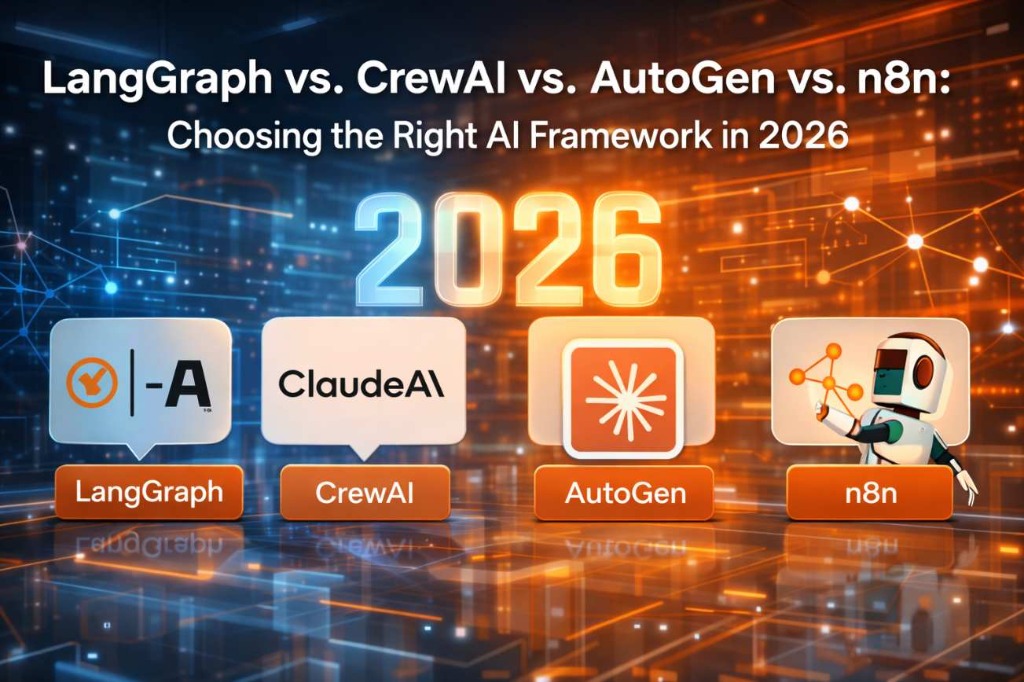
If you are trying to decide between writing raw Python code or using a visual builder, you have likely encountered the "Big Four" of agent orchestration. In this comprehensive technical guide, we will break down LangGraph vs CrewAI**, **AutoGen vs CrewAI**, and explore how **n8n AI agents fit into the ecosystem. By the end of this deep dive, you will know exactly which framework to choose based on your technical skills, workflow complexity, and enterprise requirements.
---
Why Use a Framework for Multi-Agent Systems?
Before diving into the comparisons, it is important to understand why developers use frameworks instead of just writing raw API calls to OpenAI or Anthropic.
While you *can
- build an AI agent from scratch using Python, loops, and basic API endpoints, scaling it is a nightmare. When building multi-agent frameworks, you need to manage context windows, handle memory persistence, coordinate agent-to-agent handoffs, and manage tool execution errors.
Frameworks provide pre-built abstractions for these challenges. They allow you to focus on the business logic rather than reinventing the wheel of memory management and API rate limiting.
Let's explore the four most dominant approaches to building AI agents today.
---
1. CrewAI: The Role-Based Team Builder
CrewAI has exploded in popularity because it uses an abstraction that humans already understand perfectly: the organizational structure of a company.
Built on top of LangChain, CrewAI focuses on role-based agent collaboration. Instead of thinking in terms of code loops or graphs, you think in terms of hiring a "crew." You define individual agents with specific personas, goals, and backgrounds, and then assign them tasks to complete together.
#
How it Works:
In CrewAI, you might create a multi-agent system consisting of a "Senior Researcher" and a "Lead Writer."
- The Researcher is given web-search tools to gather data on a specific topic.
- The Writer is instructed to wait for the Researcher's notes and transform them into a polished blog post.
You group them into a `Crew`, assign a process type (like sequential or hierarchical), and hit run. The agents communicate naturally, delegating tasks and sharing context to reach the final goal.
#
Pros & Cons:
- Pros: Extremely intuitive learning curve. It is incredibly fast to build prototypes and deploy business-centric workflows like marketing automation, content generation, and lead scoring. It also offers built-in caching and error handling.
- Cons: Because it operates at a higher level of abstraction, developers have less granular control over the micro-level orchestration. If your workflow requires highly complex, conditional routing (spaghetti logic), CrewAI's rigid structure can feel restrictive.
Best For: Developers and business teams who want to build multi-agent teamwork environments rapidly without getting bogged down in complex state management.
---
2. AutoGen (Microsoft): The Conversational Collaborator
Developed by Microsoft Research, AutoGen approaches multi-agent orchestration through a completely different lens: conversation.
In the AutoGen vs CrewAI debate, the biggest difference is the control flow. While CrewAI relies on defined tasks and manager-led delegation, AutoGen models interactions as a dynamic, ongoing group chat between multiple agents.
#
How it Works:
AutoGen allows you to create conversational agents that chat with each other to solve problems. For example, you can create a `CoderAgent` and a `ReviewerAgent`. If you ask the system to build a Python script, the Coder writes the code, the Reviewer critiques it, the Coder fixes the errors, and the cycle continues until the code runs perfectly.
AutoGen is particularly famous for its built-in code execution capabilities. Agents can generate code and instantly run it in a sandboxed Docker environment to verify if their logic works.
#
Pros & Cons:
- Pros: Maximum flexibility. It is brilliant for open-ended problem solving, iterative research, and software development tasks. It also natively supports Human-in-the-Loop (HITL), allowing a human user to jump into the agent chat to provide feedback or approve actions.
- Cons: Because the framework relies on natural language conversations to progress the workflow, it can sometimes lead to "conversational chaos" or infinite loops if agents fail to reach a consensus. It consumes a high number of tokens as chat history builds up.
Best For: Research environments, complex coding tasks, and scenarios where agents need to iteratively brainstorm and solve open-ended problems through dialogue.
---
3. LangGraph: The Graph-Based Enterprise Engine
When enterprises need absolute reliability, they turn to LangGraph. Built by the creators of LangChain, LangGraph rejects the idea of free-flowing conversation in favor of strict, graph-based state machines.
When evaluating LangGraph vs CrewAI, the distinction is clear: CrewAI is implicit (agents figure out how to work together), whereas LangGraph is explicit (the developer programs the exact path the agents must take).
#
How it Works:
In LangGraph, workflows are designed as Directed Acyclic Graphs (DAGs). Every agent or tool is a "Node," and the transitions between them are "Edges." As the workflow runs, a global "State" object is passed from node to node, being updated along the way.
Crucially, LangGraph allows for *cycles
- (loops). An agent can generate an output, pass it to an evaluation node, and if it fails, the edge loops it back to the first agent to try again. It also features "checkpointer" memory, meaning if an agent fails at step 15 of a 20-step process, you can pause, inspect the state, and resume exactly where it crashed without starting over.
#
Pros & Cons:
- Pros: Unparalleled control, deterministic workflows, and production-grade reliability. The stateful architecture makes it perfect for enterprise compliance, financial operations, and complex RAG (Retrieval-Augmented Generation) pipelines.
- Cons: A much steeper learning curve. It requires a solid understanding of graph theory, asynchronous Python programming, and state management. It is often considered over-engineered for simple tasks.
Best For: Senior AI developers building complex, mission-critical enterprise applications that require strict routing, durable execution, and auditable decision-making pipelines.
---
4. n8n: The Visual Low-Code / No-Code Builder
Not every AI developer wants to write hundreds of lines of Python code. Enter n8n**, a fair-code licensed visual workflow automation platform that has rapidly become a powerhouse for building **n8n AI agents.
With over 160,000 stars on GitHub, n8n bridges the gap between traditional API automation (like Zapier or Make) and cutting-edge AI orchestration.
#
How it Works:
n8n uses a drag-and-drop, node-based canvas. Recently, n8n introduced "Advanced AI" nodes built on top of LangChain. You can drag an `AI Agent` node onto the canvas, connect it to a `Chat Model` (like OpenAI or Anthropic), attach a `Window Buffer Memory` node, and connect custom `Tools` (like a Google Sheets reader or a web scraper).
You can build workflows where a webhook receives an email, passes it to an AI agent to extract intent and data, and then routes the data to a CRM—all visually, without writing code. If you need custom logic, n8n allows you to write JavaScript within specific nodes.
#
Pros & Cons:
- Pros: Incredibly fast speed-to-market. It features over 400+ native app integrations, making it trivial to connect your AI agents to the real world (Slack, Gmail, HubSpot, databases). It is self-hostable for data privacy and perfect for cross-functional teams.
- Cons: While excellent for linear workflows and basic agentic tasks, it currently lacks the deep multi-agent coordination (agents talking to agents) and complex cyclic state management found in raw LangGraph or CrewAI code.
Best For: Operations teams, automation agencies, and developers who want to rapidly deploy functional AI agents connected to real-world APIs without maintaining heavy Python infrastructure.
---
Summary: The 2026 Developer Matrix
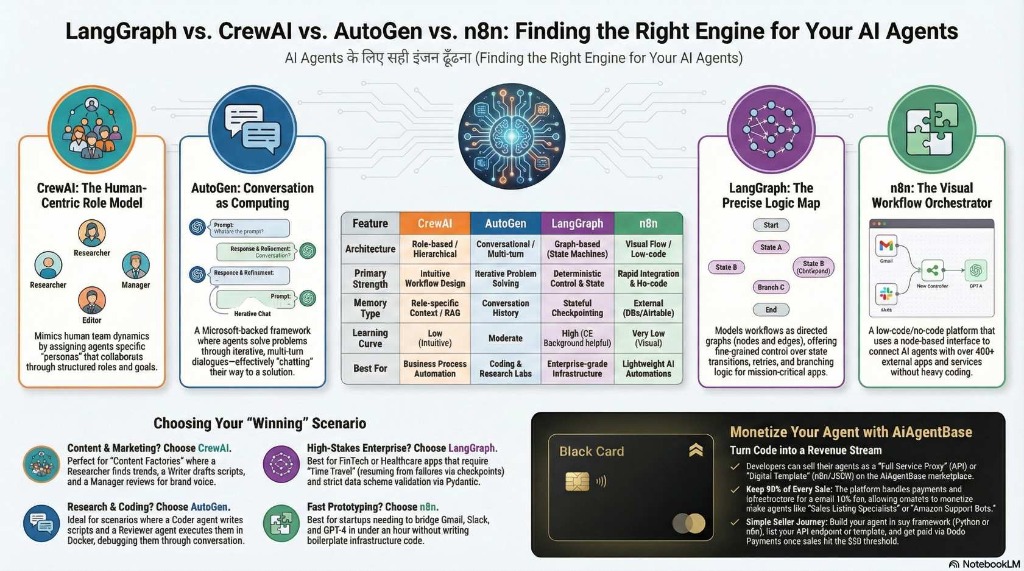
To simplify your decision, here is how the frameworks stack up:
| Feature/Need | LangGraph | CrewAI | AutoGen | n8n |
| :--- | :--- | :--- | :--- | :--- |
| Architecture | State Graphs (Nodes/Edges) | Role-Based Teams | Conversational Dialogue | Visual Node Canvas |
| Learning Curve | High (Requires Python expertise) | Low (Intuitive setup) | Moderate | Very Low (Drag & Drop) |
| Primary Strength | Complex, strict enterprise control | Rapid business workflow setup | Code execution & research | API integrations & speed |
| Target Audience | Backend & ML Engineers | Product & Business Devs | Researchers & Coders | Ops Teams & Automators |
---
Monetize Your AI Builds on AiAgentBase.app
Whether you choose the strict control of LangGraph**, the conversational dynamics of **AutoGen**, the team-oriented structure of **CrewAI**, or the visual simplicity of **n8n**, there is one universal truth in 2026: **businesses are willing to pay for your automations.
You don't need to build a massive SaaS company to generate passive income. At AiAgentBase.app, we have built the world’s first AI agent marketplace designed specifically for developers to monetize their creations.
Here is how you can turn your framework knowledge into cash:
1. Selling n8n Templates (Digital Products):
If you used n8n to build a brilliant social media content factory or an automated invoice processor, simply export your workflow as a `.json` file. You can list this n8n template on our marketplace, set your price, and keep up to 80% of the revenue. Buyers simply download your JSON and import it into their own n8n instance.
2. The Secure API Proxy Model (For Python Developers):
Did you build a complex multi-agent system using LangGraph or CrewAI? Host your Python code on your own server (AWS, Vercel, etc.) and expose it as an API. List it on AiAgentBase, and we will protect it with our Secure Proxy Layer. Users pay via our Credit System ($0.10/credit) to trigger your agent. We handle the payments, rate-limiting, and key security—you just collect your payout (up to 65% revenue share for hosted APIs).
You do the architecture; we provide the buyers and the secure payment infrastructure.
---
Conclusion
The shift from "prompting" to "architecting" requires the right tools. If your goal is to build deterministic, highly-controlled enterprise applications, invest your time in LangGraph**. If you want to orchestrate collaborative business workflows quickly, **CrewAI*
is unmatched.
Whatever framework you choose, your skills are in incredibly high demand. Start building, deploy your agents, and when you are ready to monetize, bring your tools to the AiAgentBase marketplace.
Ready to Automate?
Don't just read about AI agents—start using them. Explore our marketplace for ready-to-deploy n8n templates and custom agents.
BROWSE AGENT STORE