
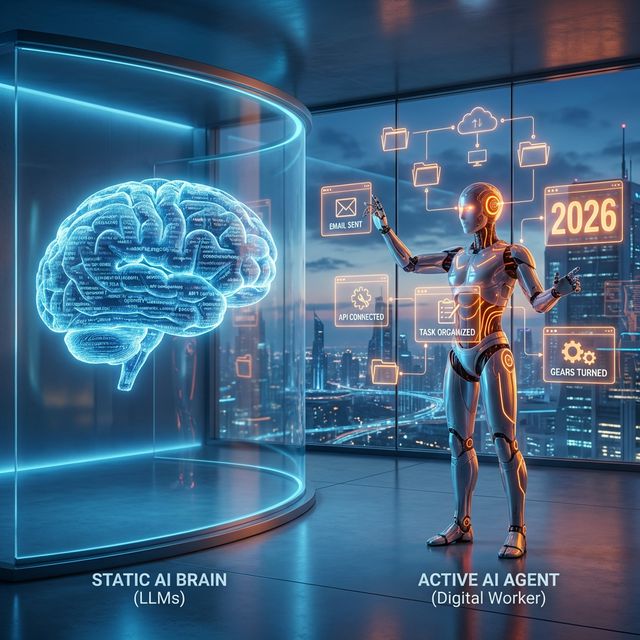
The artificial intelligence landscape is witnessing a seismic structural shift. Following the widespread popularization of Generative AI in recent years, the dominant theme in 2026 has shifted from AI "speaking like a human" to "acting like a human".
If you are a business owner or a beginner trying to navigate the modern tech ecosystem, you have likely heard the ongoing debate surrounding AI Agents vs LLM. While 2024 and 2025 were defined by chatting with intelligent text generators, 2026 marks the tipping point for "Agency AI"—systems that do not just suggest what to do, but actually go out and do it for you.
In this comprehensive guide, we will break down exactly what an AI agent is, explore the critical limitations of traditional LLMs, and uncover why 2026 has officially become the year of autonomous, agentic workflows.
---
The Limitations of Traditional LLMs (Large Language Models)
To understand why AI agents are revolutionary, we first need to understand the limitations of the technology that precedes them: Large Language Models (LLMs).
Models like ChatGPT, Claude, and Gemini are the "smooth talkers" of the AI world. They are built on transformer architectures containing billions of parameters, trained on vast amounts of text data to predict the next word in a sentence. You can ask an LLM to explain quantum physics, write a poem, or debug a block of code, and it will generate a response so fluid that it sounds like pure magic.
However, traditional LLMs have severe limitations when it comes to enterprise automation:
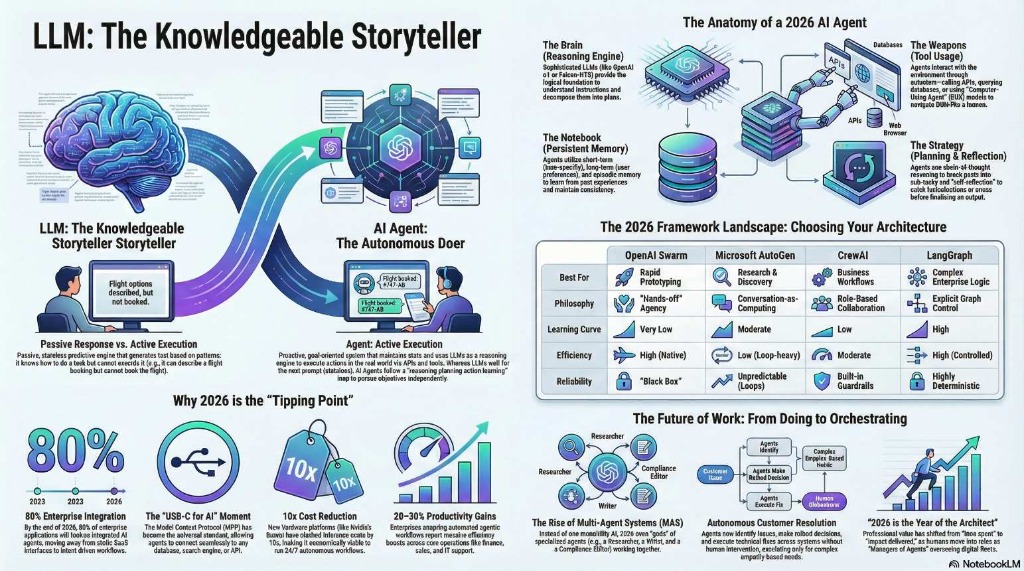
- They Cannot Take Action: LLMs are entirely passive. If you ask an LLM to book a flight to Dubai, it can generate a beautiful itinerary and tell you *how* to book it, but it cannot securely log into an airline portal, input your credit card details, and purchase the ticket.
- Digital Amnesia (Statelessness): Traditional LLMs suffer from severe short-term memory loss. Every time you open a new chat window, the model starts from a completely blank slate. It does not remember your business preferences, your past conversations, or the context of your ongoing projects unless you manually re-explain everything in your prompt.
- Lack of Compound Intelligence: Standard LLMs cannot meaningfully build on their own discoveries over time. They process your prompt, generate an output, and stop. They cannot autonomously realize they made a mistake, search the web for a correction, and fix their own work without human prompting.
In short: LLMs think and speak, but they do not act. To turn these brilliant "thinkers" into autonomous "doers," we need AI Agents.
---
What is an AI Agent?
An AI Agent is an autonomous software system powered by a Large Language Model (its "brain") that can perceive its environment, reason through complex goals, formulate a plan, and execute tasks using external tools with minimal human intervention.
If an LLM is like a highly knowledgeable consultant who gives you great advice, an AI Agent is like a dedicated employee who takes that advice, uses your company's software, and gets the job done.
To operate autonomously, an AI agent relies on four foundational pillars:
#
1. The Reasoning Engine (The Brain)
Instead of just predicting text, agents use the LLM to perform task decomposition. When given an ambiguous goal (e.g., "Find all local competitors, analyze their pricing, and create a comparison spreadsheet"), the reasoning engine breaks this massive goal into a step-by-step logical plan.
#
2. The ReAct Framework (Reason + Act)
Most modern agents operate on a cognitive loop known as ReAct (Reasoning and Acting). The agent goes through continuous cycles:
- Thought: The agent analyzes the situation ("I need to find competitor pricing").
- Action: The agent decides to use a specific tool ("I will use the web-search tool for 'local plumbing businesses'").
- Observation: The agent reads the search results and incorporates them into its context to plan the next step.
This loop continues until the final goal is fully achieved.
#
3. Tool Utilization (The Hands and Feet)
Agents are not trapped in a chat window. They are equipped with Tools (APIs, web browsers, databases, calculators, and code executors). When an agent needs real-time data, it autonomously writes an API call, fetches the data, and reads it. In 2026, standardization protocols like the Model Context Protocol (MCP) act as the "USB-C for AI," allowing agents to seamlessly plug into enterprise software like Salesforce, Slack, and Google Drive.
#
4. Advanced Memory Systems
To cure the "digital amnesia" of LLMs, AI agents are built with sophisticated memory architectures:
- Short-Term Memory: Stored in the context window to keep track of the immediate steps being executed.
- Long-Term Memory: Stored in external Vector Databases. This allows the agent to recall facts, user preferences, and historical data across days, weeks, or months.
- Procedural Memory: The agent learns *how* to do things better over time, remembering successful workflow patterns so it doesn't have to figure out a process from scratch every time.
---
Why 2026 is the Year of Autonomous (Agentic) Workflows
While 2025 was the year businesses experimented with basic AI copilots, 2026 is the year where expectations must meet technical reality, and organizations are actively transitioning from "prompting" to "architecting" autonomous workflows.
According to industry analysts, up to 40% of enterprise applications will feature task-specific AI agents by the end of 2026. Here is why autonomous workflows are taking over:
#
1. The Rise of Multi-Agent Systems (Swarm Intelligence)
We are moving away from the idea of one "God-like" AI that tries to do everything. 2026 is dominated by Multi-Agent Systems (MAS).
Instead of a single bot, businesses are deploying specialized teams of agents. For example, in a marketing automation workflow:
- A Researcher Agent scours the internet for trending topics.
- A Writer Agent takes that data and drafts a highly optimized blog post.
- A Reviewer Agent critiques the grammar, checks for brand compliance, and requests edits from the Writer Agent.
- An Executor Agent formats the final draft and publishes it directly to WordPress.
Frameworks like LangGraph, CrewAI, and AutoGen have made it incredibly easy to orchestrate these digital workforces, allowing agents to converse, debate, and verify each other's work, which drastically reduces AI hallucinations and errors.
#
2. Shifting from "Time Spent" to "Impact Delivered"
Generative AI automated routine writing, but agentic AI automates the *coordination
- of work. Business owners are realizing that employing autonomous workflows allows human workers to stop acting like data-entry clerks and start acting like "Managers of Agents". Humans will set the strategy, review the final outputs, and make high-level decisions, while fleets of AI agents handle the repetitive, multi-step execution in the background.
#
3. Real-World Business Automation
Agents are actively transforming core business operations today.
- Customer Support: Agents don't just answer FAQs anymore; they access the company database, process refunds, upgrade subscriptions, and autonomously resolve tier-1 support tickets.
- Sales & Lead Generation: Agents scrape LinkedIn for ideal client profiles, cross-reference them with the company's CRM, draft highly personalized cold emails, and automatically schedule meetings on a calendar.
- Finance & Operations: Agents monitor supply chains, extract data from PDF invoices, verify arithmetic errors, and generate compliance reports without human supervision.
---
Skip the Complex Coding: Scale Faster with AiAgentBase
The shift from standard LLMs to AI Agents represents a massive leap in business productivity, but building these systems from scratch requires deep technical expertise in orchestration frameworks, memory vector databases, and API integrations.
If you want to harness the power of autonomous workflows without spending months writing complex code, AiAgentBase.app is your ultimate shortcut.
As the world's premier AI agent marketplace, AiAgentBase allows business owners and creators to instantly buy, deploy, and run ready-made AI automations. Whether you need a fully structured n8n workflow template*
to manage your customer support 24/7, AiAgentBase has it ready.
With a flexible, pay-as-you-go Credit System, you don't have to worry about expensive monthly subscriptions. You can browse verified, high-quality autonomous tools built by top developers, plug them directly into your business, and start saving hours of manual labor today.
Stop typing prompts and hoping for the best. Start deploying agents that do the work for you. Visit AiAgentBase.app to browse the ultimate directory of premium AI agents and n8n templates.
---
Conclusion
The evolution from Large Language Models to AI Agents is the most significant technological leap since the transition from command-line computers to graphical user interfaces. LLMs gave computers the ability to understand and generate human language, but AI Agents have given them the autonomy to act on it.
By combining reasoning, memory, and the ability to use digital tools, AI agents are turning the theoretical promises of AI into tangible, economic reality. 2026 is undeniably the year of the autonomous workflow. The businesses that survive and thrive will not be the ones typing queries into a chatbox—they will be the ones employing fleets of digital agents to execute their vision at scale.
---
🔗 Useful Links:
Ready to Automate?
Don't just read about AI agents—start using them. Explore our marketplace for ready-to-deploy n8n templates and custom agents.
BROWSE AGENT STORE